Wednesday, September 15, 2010

Kaytee Koi's Choice Premium Fish Food

Kaytee Koi's Choice Premium Fish Food
Kaytee Koi's Choice Premium Fish Food is a highly digestible, floating food that is suitable for all seasons. Kaytee Koi's Choice Premium Fish Food provides necessary animal and vegetable proteins, and essential nutrients required for excellent growth, color, health and longevity.

Price: $28.99


Click here to buy from Amazon

Red Sea Diving

  I haven't posted in a while as I've recently returned from holidaying in Egypt, learning to dive in the Red sea. As a newly qualified PADI open water diver, I now feel the urge to don some scuba gear and get closer to my koi, but I'm not sure if they would appreciate it. On second thoughts perhaps not, as although I wore a wet suit and the water temperature rarely gets much cooler in the Red sea, it was still a very comfortable 24C.
I stayed in a little resort called Taba Heights that has literally sprung up over night on the edge of the Gulf of Aqaba, on a barren piece of land that backs onto the Sinai mountains. The area is a beautiful man made oasis of a handful of five star hotels and a golf course, which makes it perfect for relaxing but the real attraction is to be found on the reefs just off the beach. The variety and abundance of life in the sea is truly breath taking and something everyone should experience at least once. It's an exhilarating experience although at first it felt odd not having a sheet of glass between me and the fish. The instructors from the dive school, which is sponsored by the National Geographic, explained that we should be careful not to damage the environment as it is a protected area, but the greatest threat is not from divers but from pollution from nearby ports and fish farms.
Taba Heights is very close to the Israeli border and the city of Eilat which has many fish farms in the area, mostly for food fish but inland they do grow ornamental fish. I wasn't able to visit so I don't know if they farmed koi there or not but I have heard that scientists have been working there on a vaccine for KHV, and helped develop the process that MagNoy currently use to inoculate against the disease. Whether or not you agree with their approach, personally I think it's early days yet before anyone can claim KHV free koi for life, but their top quality koi are now very good. With their winter temperatures more like our summer in the UK, it's easy to see how the koi grow so quickly. Coming back to rainy Britain is quite a shock and makes you realise how short our growing season is without heating.
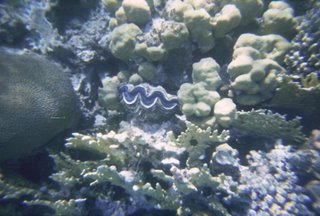
 Snorkelling off the beach I spied this Giant Clam
This holiday has made me more conscious of environmental issues, especially the threats to coral reefs some of the most delicate and important ecosystems on the planet. Some of this complexity can be thought about when compared to our koi ponds, with which we only have to provide the right conditions for one species, whereas in the seas many thousands of species rely on favourable conditions that nobody has control over. Labels: environment, fishkeeping, KHV, koi, scuba
View the original article here

Thursday, September 9, 2010

Koi Types


There are many different types of Koi, and since all the names are in Japanese keeping them all straight can be very difficult.� Using information from the website of "Koi And Water Garden Society Of Central New York" I will try to run through the basic categories and types of Koi fish.� This is an extensive list but by no means complete.

Basically there are thirteen classifications of Koi, each classification with one or more different types.

1.� Kohaku�

Red (hi, pronounced "he") markings on a white background.� One of the most common varieties, they should be a deep red with well defined edges (kiwa) the white should be pure and bright.

Tancho Kohaku: White with a red spot on the head.

Inazuma Kohaku: Has a continuous red marking from head to tail, with variation (inazuma means "lightning strike").

Nidan (two) Kohaku: With two red markings.

Sandan (three) Kohaku: This has three red markings.

Yondan (four) Kohaku: Four red markings.

2.� Taisho Sanke (known as Sanke)

Hi (red)and sumi (black) on a white background.

Maruten Sanke: Separated red spot on the head and normal markings on body.

Tancho Sanke: With a red spot on the head with a white body with black markings.

3.� Showa

Red and white markings on a black background.

Hi Showa: Is a mostly red Showa.

Kindai Showa: With a mostly white pattern.

Tancho Showa: With a red spot on the head, and a black body with white markings.

4.� Bekko

White red or yellow Koi with black (sumi) markings.

Aka Bekko: A red Koi with balck markings.

Shiro bekko: White Koi with black markings.

Ki bekko: Yellow Koi with black markings (very rare).

5.� Utsurimono

Frequently mistaken for bekko but are mostly black with red, white or yellow markings.

Shiro utsuri: Is black with white markings .

Hi utsuri: Black with red markings.

Ki utsuri: Black with yellow markings (very rare).

6. Asagi

Blue-grey Koi with red along the sides and belly and in the fins.

7.� Shusui

These are doitsu Koi (Koi with scales along dorsal and lateral lines only).� They are blue-grey with dark blue scales along the dorsal and lateral lines and red on the sides of the fins.

8.� Koromo

Koromo means 'robed'. This describes the hi (red) pattern, outlined in a darker color which varies with the variety.

Ai goromo: This is a kohaku whose scales have blue borders.

Sumi goromo: Solid black on the hi markings.

Budo goromo: Have sumi overlaying the hi giving it a purple/maroon color.

9.� Kawarimono

Kawarimono accomodates all non-metallic Koi that do not fall into the above groups.

Hajiro: Black Koi with white or orange belly.

Hageshiro: Black with white tips to fins and white head and nose.

Kumonryu: Is a Doitsu Koi which is black with white markings on its head fins and body.

Shiro Matsuba: As above but white.

Kigoi: Is a yellow Koi.

Chagoi: Is a light brown/olive Koi.

Soragoi: Is a blue-grey Koi.

Midorigoi: Is a green Koi.

Benigoi: Is a deep red Koi.

Shiro Muji: Is a white Koi, Aka Muji is a red Koi.

Ochiba Shigure: Is a blue-grey with a brown pattern.

10.� Hikarimono

Hikarimono are single colored metallic Koi.

Platinum ogon: Is metallic white.

Nezu ogon: Metallic silver-grey.

Yamabuki ogon: Yellow-gold metallic.

Orenji ogon: Deep metallic orange Koi.

Aka matsuba: Is a red Koi with black centers to is scales, creating a pine cone effect .

Ki matsuba: Is above but yellow.

Kin matsubsa: Metallic gold or orange Koi whose scales have black centers.

Gin matsuba: Is the silver version of the Kin matsuba.

11.� Hikari-Utsurimono

These are metallic showa and utsuri.

Kin showa: Have a golden lustre while Gin showa have a silver lustre.

Gin shiro: Is a metallic shiro utsuri.

Kin ki Utsuri: Is a metallic yellow utsuri.

Kin hi utsure: Is a metallic red utsuri.

12.� Hikarimono-Mono

Metallic Koi that have more than one color but aren't showa or utsuri.

Yamato-nishiki: Is a metallic sanke.

Kujaku Are platinum Koi with red markings.� The scales are overlaid with a matsuba pattern.

Platinum Kohaku: Is a metallic kohaku.

Kikisui: Is a doitsu platinum kohaku.

Gin bekko: Is a metallic shiro bekko.

Kinsui and Ginsui: These are the metallic varieties of the shusui.

Hariwake: Are platinum with orange or yellow markings. They can have regular scaled doitsu or doitsu matsuba.

13.� Tancho

These are named after the national bird of Japan, the tancho crane, which has a red spot on the head.� There are tancho kohaku, tancho Sanke and tancho showa.

14.� Kinginrin

Means 'golden silver scales' describing the sparkling scales of the kinginrin Koi.� All varieties of Koi can have kinginrin scales.� They must have more than 20 to be classified as kinginrin. Koi with silver sparkling scales are ginrin.�� Koi with golden sparkling scales are kinrin.�� Koi with both are kinginrin.

CREDITS:� Koi and Water Garden Society of Central New York Visit them at:� www.cnykoi.com

------------------------

Mark Justice is a koi fish enthusiast. For more information on koi types, visit http://www.raisingkoifish.com

Source: http://www.submityourarticle.com

Permalink: http://www.submityourarticle.com/a.php?a=117687

Saturday, September 4, 2010

5 Ways To Keep Your Koi Healthy

Ever considered about what if you really could keep you Koi fish from contracting disease? That exact same idea has occurred to many people. Some have in reality tried it.

Hmm. Is this actually possible? Did they actually stay healthy with no treatment? We've seen what happens when they don't, and don't want that happening in our pond. The negatives have been covered very well, but why not consider the positives? Before we let the negatives rule, the positives deserve a fair hearing. Let's examine 5 positive reasons in favor of trying to keep your Koi healthy to start with and pay attention to which ones ring true.

First, forget Koi treatment for a moment.. Sure, I understand your objection that treating your Koi for disease is sometimes necessary.. Certainly that is a valid objection. However you need to consider preventive measures that will keep them healthy to start with.. And moreover, one should consider we can still treat the Koi when (and it will) preventions fails.

Second, Stressed Koi Fish are prone to disease. You may think this is weird but nonertheless it is a fact...Koi are easily stressed by many factors including poor water conditions, poor feeding shedules and predators just to name a few.

The main reason behind that would be that stress slowly but surely diminishes their immunity and of course a lower immune system will make them vulnerable to any kind of disease.... And also healthy Koi are more disease resistant and less likely to succumb to disease.

Third, Provide your Koi with high quality water. Think about it, the Koi breath in this water. And in addition good water quality will drastically reduce the level of stress of Your Koi.

Fourth, Don't overfeed your Koi. This creates a dirty pond which will affect their health. Regular pond clean-up and good filtrations is a must. Feed only waht the Koi can eat in about 15 minutes.

And Fifth, When Koi treatment does become necessary there a a number of treatments you can use. Most often full pond treatment will be advised. Occasianally individual hands on treatment will be advised for the individual fish. You will want to consult your local pet store or your Koi supply store for the best treatments. If the problem is severe you may need to call you Veterinarian.

Within all of the above info lies a very good list of reasons in favor of keeping your Koi healthy to start with. Reduce stress, keep your pond clean. and do not overfeed. This should go far in keeping you Koi fish happy and healthy for a long time to come. And that in turn should help keep YOU stress free as well.

Uncover the way to keep your Koi healthy and avoid treatment at our Koi Treatment site athttp://raisingkoifish.com.

Tuesday, August 31, 2010

Koi Images

Koi images are used by Koi hobbyists for many different reasons. The methods they use can be determined by how they are going to use them. Images of the fish and the Koi ponds as well can be used.

Many Koi enthusiasts like to document the progress the fish are making in growth and coloration, as it can be used as a measurement of their good health.

Commercial breeders and sellers as well as hobbyists frequently use pictures to buy sell and trade fish over the internet. Images of these beautiful and colorful fish work very well to show off these fish. Using email or images on various websites can save a great deal of time and possibly travel to view the Koi live.

Pictures of Koi ponds are also a great way to get ideas for designing and building your own pond. These images are also great for planning your landscaping around the pond.

The use of beautiful plants as well as a wide variety of waterfall displays and arched bridges and distinct lighting arrays can be seen. They can be a great help guiding you through the design process of you pond. a search on Google will result in thousands of images to view. Plenty to get you started on an assortment of design ideas.

Taking pictures of your Koi fish is not as easy as it looks, and takes a great deal of patients. If your want to try taking picures of your fish and pond here are some pointers to help:

Koi are always on the move and they tend to dart around so you'll want to set your shutter speed to maximum in order not to blur the pictures.

Use as many different angles as you can. Many of your pictures won't turn out, but if you take a lot of pictures and have a wide variety of angles, your sure to have plenty of usable pictures. You may want to use something like a ruler or an object that will give your fish and the pond some size perspective in order to measure the progress you fish have made in growth and coloration.

For light colored fish you should use a contrasting dark colored background and for dark fish use a light colored background. Whatever you do remember to take your time and be patient. The Koi will move at their own pace and you will find that you have to adjust to them.

Take lots of pictures from lots of angles. And as many different lighting settings as you can and you should have plenty of good pictures to choose from.

The use of images will surely make the adventure of Raising Koi Fish a much more delightful pastime.

Mark Justice is a koi fish enthusiast. For information on koi images, visit http://www.raisingkoifish.com

Saturday, August 21, 2010

The Many Colors of Koi

The Japanese have taken a great deal of pride in the careful breeding of Koi Fish to produce the many different fabulous colors and patterns that are available today. Koi fish are loved and treasured by their owners because of the gorgeous colors and patterns available.

The colors of the Koi Fish should be vivid and bright. Yellow Koi should be a vivid yellow, and black Koi should be a deep jet black. Dullness of color or spots that are slighly off color are undesirable qualities. Just as white Koi that are not pure white but contain specks of gray. Color is an indicator of the Koi's overall good health. Poor health as well as poor water conditions will cause the Koi to lose color and become dull and drab. Understanding the importance of color and what the colors should be will help a great deal when you are selecting your Koi. It will also help to keep an eye on the color at home as you are raising them to be sure the water conditions and care you are giving them is the best quality possible.

Koi Fish come in a large variety of colors. Some of the most seen Koi colors are red, black, white, green, blue, yellow and cream. Certain terms and descriptions are used by the Japanese to describe the different colors and traits of the Koi Fish, There are a large number of categories that have been identified by Koi breeders. Gosanke is the most popular variety and it includes many sub-categories such as Kohaku, Taisho Sanshoki and Showa Sanshoki Koi. The Kohaku are white with red patterns. The white on this breed of Koi should be pure white and the red should cover 50 to 70 percent of the body with well defined edges.

The Taisho Sanshoki category or Taisho Sanke or just Sanke, as they are also known, are white fish with red and black markings. Again the white coloring should be pure white and the black and red should be bright colors with distinct edges. Like the Sanke category of Koi, the Showa Sanshoki, or just Showa category are white black and red in color as well. The main difference is the black is the predominant color, with red and white markings. There are many other varieties that each come in their own color variations. The Ogon come in an assortment of colors but they are all one color. They sould be a solid bright color with no patterns, or markings at all.

You can help keep you Koi's colors bright and distinct by feeding them a rich diet. Some examples of the things added to a rich commercial diet are shrimp, marigold, plankton, and blue-green alge known as Spirulina. These foods are specifically geared to enhance the colors and markings of the Koi. Also, adding foods such as freeze dried brine shrimp and daphnia, you are ultimately feeding them color anhancing foods. Each of these fodds have high concentrations of carotenoids, and carotenoid pigments are the major pigments in the Koi's skin.

The Many Varieties of Koi Fish

Way back in the 1820's when the Japanese began breedingKoi Fish they only came in one or two colors. They were started from carp mutations and so they were initially very limited. Then as the popularity of Koi exploded and more and more people began breeding them, gradually the variety of patterns and colors began to expand. They now come in a rainbow of colors and patterns including red, yellow, black, blue, green and White Koi.

In order to easily recognize the different varieties of Koi Fish you will need a basic understanding of the classifications the various Koi are divided into. There are different standards for each variety but a certain amount of diversity is usually acceptable. A couple stand out as the most popular varieties. Kahaku Koi is one of the most popular varieties. Another popular variation is the Hikarimono or Ogon Koi.

In the term Hikarimono the "Hikari" means metallic and the "Mono" simply means single color. So these Koi Fish are all one color but with a metallic appearance. They usually appear as Yamabuki Ogon or yellow and in white or silver and referred to as Platinum Ogon. Regardless of the color or the variety they should be the same shade of color from the head to the tips of their fins. In order to offset the plain color they have been bred to have larger fins for a better display.

Unique and popular in the world of Koi are the White Koi or Platinum Ogon, whose bodies appear to shine like the luster of precious metal. First appearing in 1963, these unique and glamourous Koi Fish were probably crossed with the Kigoi or graysh-silver Nezu(from the Japanese word "rat" or nezumi) Ogon. These have become very popular because they are easily cared for, are hardy and grow very rapidly. Standing out and easily seen in murky water they are the perfect choice for poorly filtered ponds. Nezu, Orenji and the Fuji Koi are other varieties of the Ogon Koi.

Most of the Platinum Ogon Koi are bred with what is known as Ginrin scales. The Ginrin scales make them appear even shinier, and are very different than the scales seen on the metallic or "Hikarimono". The regular scales have somewhat of a sheen on them and the Ginrin scales have a highly refective sheen over all or part of the scale. This creates a shimmering effect much like cut diamonds. In order to qualify as Ginrin they should have more of these scales than one can count as it swims past an onlooker. The accepted minimum is about 20 scales.

The large variety of colors and patterns is the main attraction for pond enthusiasts fo fill their pond with Koi Fish. Viewing directly from the top is the best way to see the Koi in all their splendor. Most of the Koi's pigment is in the top side of the fish. In Koi Fish shows in Asia the Koi are always viewed from top in round pools.